
News and Views
AI Banking Strategy 2027: Transform Branches into Intelligent Banking Platforms



AI Banking Strategy 2027: Transform Branches into Intelligent Banking Platforms
Artificial intelligence is changing more than banking technology. It is changing how banks understand customers, organise operations, deliver advice, manage service journeys and determine the role of the physical branch.
For bank executives, the strategic question is therefore no longer simply how to introduce AI into banking.
It is: How should an AI banking strategy change the customer experience, operating model, branch proposition, network and economics of the bank?
An effective AI banking strategy connects data, automation, customer intelligence, human expertise, brand experience and physical environments into one commercially coherent model.
The objective is not to make banking look more technological.
It is to make banking more relevant, simpler to navigate, more responsive and more valuable to customers and the bank.

Why Banks Need an AI Banking Strategy for 2027
AI adoption is moving from isolated experimentation towards broader changes in how financial institutions operate and serve customers.
The UK Financial Conduct Authority's 2026 review of AI in retail financial services identifies four major areas of potential change: firm operations, consumer journeys, competition and market power, and fraud and cyber risks.
The Bank of England likewise identifies opportunities for AI to improve productivity, decision-making and customer services, while emphasising the need to understand risks to firms and the wider financial system.
For bank management, this creates five connected priorities:
- Customer value - where AI can make financial journeys simpler, faster and more relevant.
- Operational value - where automation and intelligence can reduce friction and cost-to-serve.
- Employee value - where AI can give colleagues better information and more capacity for valuable customer interactions.
- Network value - how changing customer behaviour affects branch roles, formats, locations and investment.
- Brand value - how banks can use intelligence without weakening trust, transparency or human relationships.
The opportunity is therefore to move beyond isolated AI applications towards an intelligent banking operating model.
How CampbellRigg helps
CampbellRigg begins with the management and customer-experience implications of AI rather than starting with technology.
We audit the existing customer journey, brand experience, branch proposition and physical network; identify where digital and AI capability can change the experience; and translate those findings into a strategic design brief.
The benefit: management gains a clearer connection between AI investment, customer experience, physical banking and commercial performance.

AI Is Changing the Banking Operating Model
An AI banking strategy should not be treated as another technology programme.
It changes how the bank gathers information, makes decisions, serves customers and deploys human expertise.
A useful management framework is to consider AI across seven layers.
1. Customer intelligence - AI can help banks identify customer intent, behaviour, needs and relevant next actions.
The commercial opportunity is not simply greater personalisation. It is a more useful relationship in which the bank can anticipate needs and reduce unnecessary effort.
2. Employee intelligence - AI can support relationship managers, advisers and branch colleagues by bringing relevant customer information and recommendations into the interaction.
The objective should be to increase the quality of human service rather than simply remove human involvement.
3. Process intelligence - Routine activities can increasingly be automated, reducing repetitive work and allowing employees to concentrate on more complex interactions.
4. Decision intelligence - AI can support prioritisation, recommendations, forecasting and resource allocation.
Management must nevertheless determine where automated recommendations are appropriate and where human judgement remains essential.
5. Experience intelligence - Customer journeys can become more responsive when AI connects information across channels.
A customer should not have to repeatedly explain their circumstances simply because they move from an app to a website, contact centre or branch.
6. Branch intelligence - As routine activity becomes increasingly digital, branches can be redesigned around the interactions where physical presence creates additional value.
7. Network intelligence - AI-generated insight can contribute to decisions about locations, formats, capacity, staffing, customer demand and investment.
The implication is important: AI banking strategy should influence the physical network strategy, not sit separately from it.

From Customer Data to Intelligent Customer Experience
The real value of AI appears when intelligence improves the complete customer journey.
A customer might begin by exploring a financial need digitally, receive relevant information or recommendations, request human advice, visit a branch for a complex discussion and continue the relationship through digital channels.
The experience should feel like one relationship rather than a sequence of disconnected channels.
For management, this requires a shift from measuring individual channels to measuring complete customer journeys.
Key questions include:
- Where does customer friction occur?
- Which interactions should be automated?
- Where is human advice commercially valuable?
- What information should follow the customer between channels?
- How can employees receive better context before an interaction?
- Which journeys should begin digitally and finish with human advice?
- Which physical interactions genuinely add value?
- Where does AI improve conversion, retention or customer lifetime value?
How CampbellRigg helps
CampbellRigg maps the customer journey from discovery through engagement, advice, application, fulfilment and ongoing relationship.
We then identify where brand, environment, digital touchpoints, service behaviour and physical space need to work together.
The benefit: AI becomes a customer-experience strategy rather than a collection of disconnected technology features.

What AI Should Automate and What Should Remain Human
One of the most important decisions in an AI banking strategy is determining the appropriate division between automation and human expertise.
AI is well suited to:
- routine information retrieval
- service triage
- appointment preparation
- product discovery
- customer-service assistance
- document handling
- pattern recognition
- operational forecasting
- routine process automation
- proactive service prompts.
Human expertise remains particularly valuable for:
- complex financial decisions
- mortgages and major borrowing
- wealth and investment conversations
- business banking
- vulnerable or sensitive customer situations
- difficult financial circumstances
- relationship development
- reassurance and trust
- decisions requiring judgement and accountability.
The strategic principle is: Automate friction. Preserve human value.
The objective is not an AI-only bank.
It is a bank in which AI handles appropriate complexity at machine speed while people concentrate on the interactions where expertise, judgement and trust matter most.
This distinction is becoming increasingly important as AI moves into more consequential financial activities. Regulatory and industry bodies continue to emphasise accountability, governance, model risk, privacy and resilience alongside innovation.

How AI Changes the Economic Role of the Bank Branch
AI does not automatically make the branch irrelevant.
It changes the question management should ask.
Instead of: “How many branches should we operate?”
the more useful question is: “What economic and customer role should each branch format perform?”
A branch may contribute through:
- financial advice
- complex product conversion
- mortgage and lending discussions
- wealth relationships
- business banking
- customer acquisition
- assisted digital adoption
- financial education
- customer recovery
- relationship development
- trust and reassurance.
Routine transactions may require less physical space as digital and self-service capability expands.
That creates an opportunity to reconsider how space is allocated towards higher-value interactions.
But the outcome should not be predetermined.
A bank's network strategy should reflect: customer demand + local catchments + branch performance + advisory requirements + operating costs + competitive conditions + strategic role.
How CampbellRigg helps
CampbellRigg evaluates the branch as part of the wider banking proposition.
We examine customer behaviour, location, circulation, service requirements, digital adoption, self-service, brand communication and physical experience before defining the appropriate branch role.
Our Barclays work demonstrates this approach. The programme involved a multi-channel branch audit covering location, physical environment, communications, technology, self-service and operational workflows before recommendations for phased retail-platform transformation.
The benefit: branch investment is connected to customer behaviour and network economics rather than driven by a generic “branch of the future” template.

AI Banking Strategy and Branch Network Planning
AI should influence branch-format strategy at network level.
Different locations may require different roles.
A bank could, for example, operate a network incorporating:
- advisory-led flagship environments
- relationship-focused standard branches
- digitally enabled convenience formats
- specialist business banking locations
- smaller service points
- appointment-led advisory environments.
The important issue is not the number of formats.
It is whether each format has a clearly defined: customer proposition → economic role → space allocation → technology model → staffing model → implementation standard → performance measurement.
This is where AI banking strategy becomes a physical network strategy.
How CampbellRigg helps
CampbellRigg evaluates the branch as part of the wider banking proposition.
We examine customer behaviour, location, circulation, service requirements, digital adoption, self-service, brand communication and physical experience before defining the appropriate branch role.
Our Barclays work demonstrates this approach. The programme involved a multi-channel branch audit covering location, physical environment, communications, technology, self-service and operational workflows before recommendations for phased retail-platform transformation.
The benefit: branch investment is connected to customer behaviour and network economics rather than driven by a generic “branch of the future” template.

AI Banking Strategy Must Connect to Commercial Performance
The business case for AI cannot stop at technology adoption.
Management needs to understand how transformation affects:
Customer performance
- customer satisfaction
- retention
- journey completion
- customer effort
- digital adoption
- assisted-digital adoption
- advisory utilisation.
Commercial performance
- conversion
- revenue per customer
- relationship value
- customer lifetime value
- product penetration
- sales per branch
- sales per square metre
- return on invested capital.
Operational performance
- cost-to-serve
- service time
- employee productivity
- automation rates
- branch utilisation
- space efficiency
- implementation cost.
Experience performance
- journey friction
- digital-to-physical continuity
- advisory experience
- privacy
- accessibility
- brand consistency
- customer trust.
The precise measures will differ between institutions.
The principle is consistent: AI banking strategy should define measurable business outcomes before defining the physical intervention.
How CampbellRigg helps
CampbellRigg translates strategic objectives into design and implementation requirements.
If management's objective is to increase advisory activity, the branch should provide the privacy, visibility, customer flow and digital support required to facilitate better advisory conversations.
If the objective is to reduce transaction cost, routine activities can be redirected towards digital and self-service channels while physical space is concentrated on higher-value interactions.
If the objective is customer retention, the experience must become more consistent across mobile, digital, contact centre and branch.
The benefit: the branch becomes an instrument for delivering the bank's commercial strategy rather than a property cost operating independently of it.

AI Banking Requires Trust, Governance and Human Oversight
AI can improve banking experiences, but intelligence without trust can damage the customer relationship.
An effective AI banking strategy therefore needs to address:
- data governance
- privacy
- consent
- security
- transparency
- explainability
- human oversight
- responsible use of customer information
- escalation procedures
- brand consistency.
The FCA reports that AI adoption is already widespread across UK financial services, while identifying cybersecurity and accountability among the key considerations for firms.
The BIS has similarly identified risks around data security, model behaviour, confidentiality, reputation and over-reliance on AI systems.
For the customer, the principle is straightforward.
They should understand when they are interacting with AI and when human intervention is available.
They should also be able to access appropriate human support when the financial decision is significant, sensitive or complex.
This makes brand trust part of AI strategy.
How CampbellRigg helps
CampbellRigg translates strategic principles such as trust, reassurance, transparency and simplicity into the visible customer experience.
That includes:
- brand identity
- messaging hierarchy
- environmental communication
- wayfinding
- digital-to-physical continuity
- advisory environments
- privacy
- customer-facing technology.
The benefit: the physical and branded experience reinforces the bank's technology proposition rather than creating a disconnect between what the bank promises and what customers experience.

AI Should Make Banking More Human - Not Less
The most effective AI banking strategy is not necessarily the one that automates the most activity.
It is the one that creates the greatest value from the combination of intelligence and human expertise.
AI can remove repetitive work.
People can provide context.
AI can identify patterns.
People can interpret circumstances.
AI can prepare an interaction.
People can build trust.
AI can simplify access.
People can provide reassurance when the financial decision matters.
This distinction is critical for branch transformation.
The physical branch should not become a showroom for technology.
It should become a place where technology quietly improves the customer journey while people concentrate on the interactions where human expertise creates additional value.

How CampbellRigg Translates AI Strategy into Banking Experience
A successful AI banking strategy must eventually become tangible.
CampbellRigg's role is to translate strategic transformation into a coherent customer-facing and physical banking proposition.
1. Audit - Assess the existing brand, customer journey, branch network, formats, environments and customer interactions.
2. Strategise - Define the role AI should play in customer experience, service delivery and branch transformation.
3. Map the experience - Identify the digital, physical and human interactions across priority customer journeys.
4. Define the branch role - Determine which customer needs should be digital, assisted digital, self-service or human-led.
5. Define the format strategy - Establish the role, proposition, capacity and economics of each branch format.
6. Construct the design brief - Translate the strategy into a clear brief covering brand, spatial planning, communications, technology integration and customer experience.
7. Prototype and refine - Develop environments and customer-facing solutions that can be tested against strategic and commercial objectives.
8. Standardise - Create repeatable design and brand principles that enable consistent implementation across the network.
9. Implement and measure - Support rollout while establishing performance measures for customer experience, commercial return, operational efficiency and network performance.
The benefit: management can move from AI ambition to a defined, implementable banking experience strategy.

CampbellRigg Banking Transformation: Evidence of Relevant Capability
CampbellRigg's banking portfolio demonstrates relevant experience in translating banking strategy into customer experience, branch planning, brand environments and scalable physical propositions.
Barclays: From Branch Audit to Retail Platform Strategy
CampbellRigg's Barclays programme involved a multi-channel audit across branch formats, assessing location and positioning, physical environment, customer behaviour, technology, self-service and operational workflows.
The recommendations included phased transformation, balancing immediate improvements with longer-term infrastructure changes and prioritising actions according to potential impact.
Relevance to AI banking strategy: the work demonstrates the importance of connecting customer behaviour, digital adoption, branch operations and physical environments before making network transformation decisions.
Promsvyazbank: Format Planning with Measurable Commercial Outcomes
For Promsvyazbank, CampbellRigg undertook branch auditing, interior design, brand communications and format planning across the network.
The published case study reports that the new concept was 15% cheaper to implement, while the bank's Net Promoter Score position moved from 10th to 5th in its benchmark measures.
Relevance to AI banking strategy: technology transformation ultimately needs to translate into commercially disciplined customer and branch propositions.
Zenit Bank: Brand, Experience and Flexible Branch Planning
For Zenit Bank, CampbellRigg integrated brand identity, interior and exterior design, spatial planning, merchandising systems and graphic communications.
The resulting environment incorporated flexible configurations for advisory, digital and self-service interactions alongside a more open customer environment.
Relevance to AI banking strategy: intelligent banking requires the physical environment, brand and customer journey to evolve together.
These projects are not presented as AI implementations. They demonstrate the underlying transformation capabilities required when technology, customer behaviour, brand and physical banking environments change together.

How Banks Should Measure AI-Enabled Retail Transformation
AI banking strategy should be measured through business outcomes rather than technology deployment alone.
Customer measures
- customer satisfaction
- retention
- journey completion
- customer effort
- digital adoption
- assisted-digital adoption
- advisory utilisation.
Commercial measures
- conversion
- revenue per customer
- relationship value
- customer lifetime value
- product penetration
- sales per branch
- sales per square metre
- return on invested capital.
Operational measures
- cost-to-serve
- service time
- employee productivity
- automation rates
- branch utilisation
- space efficiency
- implementation cost.
Experience measures
- journey friction
- digital-to-physical continuity
- advisory experience
- privacy
- accessibility
- brand consistency
- customer trust.
The critical management principle is: Do not measure AI activity when the objective is business transformation. Measure the customer, operational and commercial outcomes that AI is intended to improve.

The Management Agenda for AI Banking Strategy 2027
Before committing significant investment, banking executives should be able to answer nine questions:
1. Where can AI create measurable customer value? Identify the journeys where intelligence can genuinely reduce effort or improve outcomes.
2. Where can AI create measurable operational value? Prioritise processes where automation can reduce friction, cost or employee workload.
3. Which interactions should remain human? Define where expertise, judgement and reassurance create additional value.
4. How should the branch role change? Identify the customer needs that justify physical presence.
5. What should each branch format achieve? Give every format a defined customer proposition and commercial role.
6. How should AI change the customer journey? Connect digital discovery, AI assistance, human advice, branch interaction and ongoing relationship management.
7. How will the bank protect trust? Build governance, transparency, privacy and human oversight into the customer proposition.
8. How can the strategy scale? Create standards, formats, design principles and implementation systems that can be deployed consistently.
9. How will management measure the return? Connect AI investment to customer, operational, commercial and experience KPIs.
These questions turn AI from a technology agenda into a banking transformation agenda.
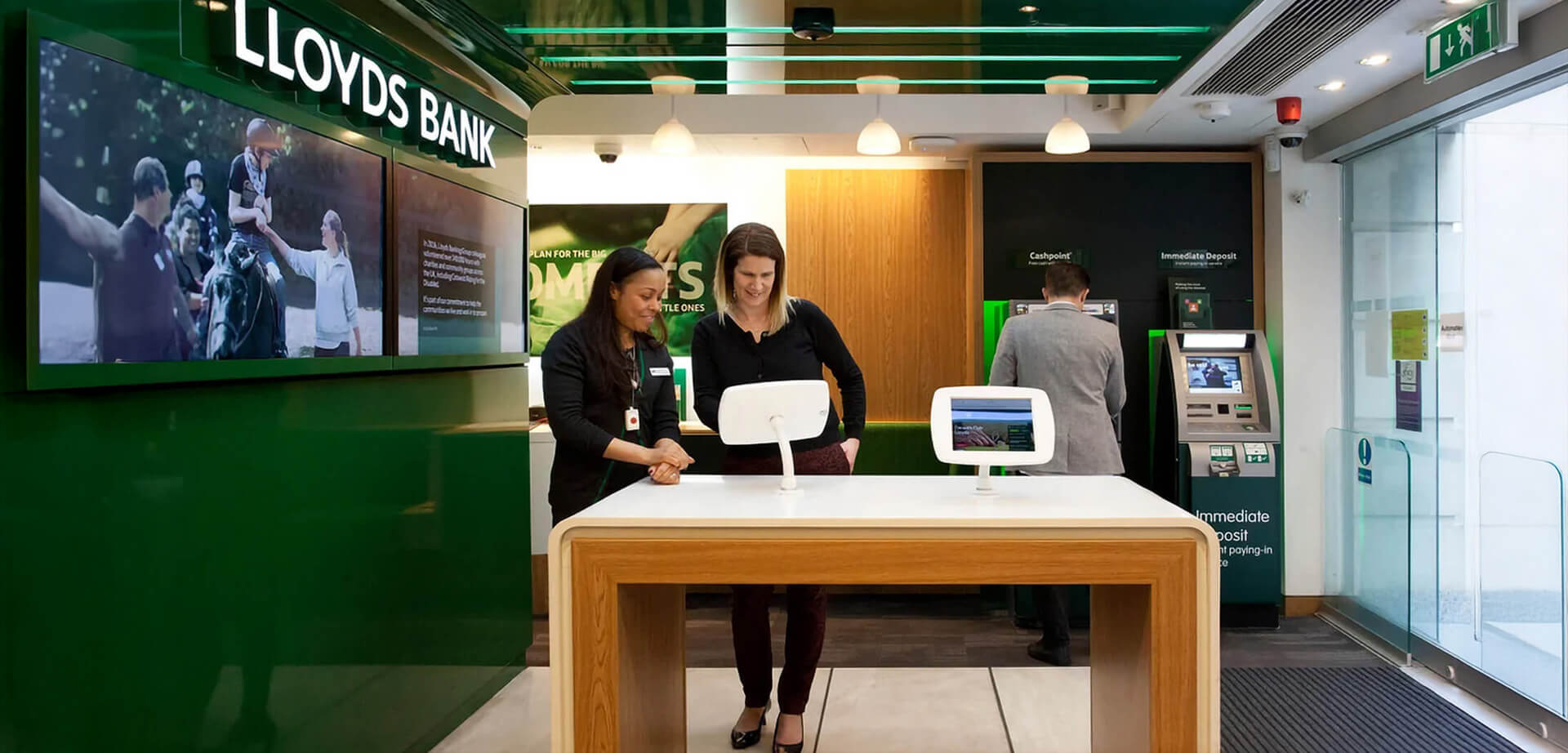
How can traditional banks can respond? Branches provide trust, complex transaction support, and advisory services.

CampbellRigg specialises in designing future-ready banking environments that integrate brand strategy, digital technology and spatial design.
Our work helps financial institutions transform traditional branches into modern customer experience hubs that support growth, loyalty and operational efficiency.
By combining strategic insight with innovative design thinking, we help banks create branch networks that thrive in the phygital era.

Our Four-Step Process:
1. Book a consultation call for free.
2. Co-create a bespoke brief.
3. We execute the creative work fast.
4. You see sales, brand loyalty and market share uplift.

The Future of AI Banking Strategy Is Intelligent, Human and Commercial
AI will continue to change how customers discover products, receive service, make decisions and interact with their banks.
But technology alone does not create a successful banking proposition.
The strategic opportunity is to connect: AI + data + human expertise + customer experience + brand + physical banking + measurable commercial performance.
For some banks, this may mean fewer routine branch transactions. For others, it may mean different formats, greater advisory capacity, redesigned customer journeys or a more targeted physical network.
The response should be determined by customer behaviour, economics, risk, operational requirements and strategic objectives — not by technology for its own sake.
The future branch is therefore not simply a traditional branch with more technology.
It is a physical component of an intelligent banking ecosystem.
And an AI banking strategy is not simply an IT roadmap.
It is the management framework that determines how intelligence changes the customer, the employee, the branch, the network and the economics of the bank.
Build the AI Banking Strategy Behind the Customer Experience
CampbellRigg helps banks translate transformation strategy into customer experience, brand, branch formats, spatial environments and scalable implementation.
From audit and strategy through customer journeys, branch-format planning, design briefs, brand experience and implementation, we help management teams define what the future banking experience needs to achieve, then turn that strategy into a practical, measurable proposition.
The objective is not to make banking look more technological.
It is to make the bank more intelligent, more relevant, easier to use and commercially stronger.
Build an intelligent banking experience designed around the customer, the network and the commercial objectives of the bank.