News and Views
Phygital Banking Strategy 2026/27: How Banks Can Redesign Branch Networks




Phygital banking strategy is changing how banks design, operate and invest in branch networks.
For bank CEOs, retail banking directors and transformation teams, the strategic issue is no longer simply whether customers will continue moving between mobile banking, digital platforms and physical branches. It is how the physical network should be configured so that digital convenience, human expertise, brand experience and commercial performance work as one system.
The modern bank branch is moving beyond its traditional role as a transaction centre. It is becoming a connected customer-experience, advisory and relationship environment in which digital services, physical space, employees, technology and brand work together.
For management, the objective is not to create a more attractive branch. It is to create a scalable, measurable and commercially effective branch network in which every format has a defined role, every location has a clear customer proposition and every investment can be linked to customer, operational or commercial outcomes.
That makes phygital banking strategy a network transformation challenge, not simply a branch design challenge.
The strategic shift: from digital branches to connected branch networks
The future of phygital banking is not about making every branch more digital. It is about determining what every physical location should accomplish within the bank's wider customer, brand and commercial strategy.
A phygital banking strategy connects mobile banking, digital self-service, human advice and physical space into one coherent customer journey. The branch becomes one component of a wider banking network rather than an isolated destination.
This requires a shift from branch-by-branch design to a scalable network model: Bank strategy → customer needs → network roles → branch formats → customer journeys → spatial design → implementation standards → measurable performance
The result should be a physical banking network that is easier to scale, more relevant to changing customer behaviour and capable of delivering measurable commercial value.
The management questions
Before redesigning a branch, bank management should establish:
- Which customer journeys should remain predominantly digital?
- Where does physical interaction create additional commercial or relationship value?
- Which services require specialist human expertise?
- Which interactions require privacy?
- How much space should be allocated to advice, service and self-service?
- Which locations require full-service, compact or specialist formats?
- How should digital and physical channels exchange information?
- How should different branch formats operate within one network?
- How should property investment reflect local demand?
- Which KPIs will determine whether transformation has created value?
These decisions should precede detailed interior design.
How CampbellRigg helps
CampbellRigg brings brand strategy, customer journey planning, format architecture, design brief construction and physical implementation together.
The process can move from: Brand audit → strategic proposition → customer journey → format architecture → design brief → spatial planning → implementation standards
This creates a single strategic direction linking customer behaviour, brand, physical investment and network performance rather than a series of disconnected design initiatives.
The benefit: management gains a practical framework for deciding what should change, where investment should be concentrated and how the branch network should evolve.

What is phygital banking?
Phygital banking integrates physical branches with digital banking platforms, self-service technology, data, AI-enabled services, human expertise and branded customer experience.
It is more than installing digital screens in a branch.
A genuine phygital banking strategy connects the customer's journey across channels.
A customer might discover a mortgage through a digital channel, research products online, book a branch appointment through a mobile application, receive specialist advice in person, complete documentation digitally and continue managing the relationship through mobile banking.
The branch therefore becomes part of a connected banking ecosystem rather than an isolated physical channel.
Digital banking versus phygital banking
Digital banking delivers services through digital channels.
Phygital banking connects: digital channels + physical environments + human expertise + customer journeys + brand experience + performance
The distinction matters because it changes the strategic question.
Instead of asking: “How should we redesign our branches?”
management should ask: “What role should the physical branch play within the complete customer relationship?”
That question determines everything that follows, from network architecture and format selection to spatial planning, technology integration and investment priorities.
How CampbellRigg helps
CampbellRigg maps digital and physical customer journeys before defining the physical environment.
The journey can be analysed from: Discovery → research → information → appointment → branch visit → advice → application → follow-up → ongoing digital relationship
The physical environment is then designed around the points where human interaction, trust, privacy, expertise or brand experience create additional value.
The benefit: physical investment decisions are based on the complete customer relationship rather than on branch interiors in isolation.

Why banks are redesigning branch networks
Three structural forces are accelerating bank branch transformation.
1. Digital banking has changed customer expectations
Customers increasingly expect banking to be convenient, fast and personalised.
They can research products, manage accounts, transfer money, communicate with their bank and begin applications through digital channels.
A branch that simply replicates services already available through an app provides limited additional value.
The physical network therefore needs a clearer strategic purpose.
The question is no longer how many traditional transactions a branch can process.
It is what additional value the physical environment can create.
That value may come from:
- specialist advice;
- complex financial decisions;
- relationship management;
- customer reassurance;
- financial education;
- assisted digital services;
- product discovery;
- community engagement;
- brand experience; and
- higher-value customer relationships.
2. Complex financial decisions still benefit from human expertise
Mortgages, investments, wealth management, business finance, retirement planning and other significant financial decisions can involve complexity, uncertainty and personal circumstances.
Customers may want to discuss important decisions with an experienced professional.
The future branch therefore needs to combine digital convenience with human judgement rather than choosing between the two.
This increases the importance of advisory environments, privacy and flexible meeting spaces.
3. Branch economics are changing
Traditional transaction-led networks can require substantial property, staffing and operational investment.
Management therefore needs to understand the role and economics of every physical format.
The question becomes how physical space can contribute more effectively to:
- customer acquisition;
- product conversion;
- advice;
- retention;
- relationship value;
- employee productivity;
- digital adoption;
- customer satisfaction;
- space utilisation; and
- network efficiency.
How CampbellRigg helps
CampbellRigg can audit existing formats, customer journeys, communications, spatial planning and brand expression before establishing requirements for the future network.
The objective is to identify: what should change → where it should change → why it should change → what it should achieve
The benefit: management has an evidence-led basis for allocating transformation investment rather than redesigning branches according to inherited formats or aesthetic preferences.

Redesign the branch around customer value
A phygital branch should be organised around customer activity rather than inherited operational processes.
Traditional banking environments were frequently structured around queues, counters and desks.
A future-ready branch can instead combine:
- digital discovery;
- self-service banking;
- assisted digital support;
- financial education;
- open advisory areas;
- private consultation rooms;
- flexible meeting spaces;
- remote specialist advice;
- technology-enabled demonstrations;
- hospitality-led waiting environments; and
- intuitive wayfinding.
The objective is not to fill the branch with technology.
Technology should remove friction and support the customer journey.
Physical space should concentrate on activities where presence, trust, privacy, expertise and human interaction create additional value.
From customer process to spatial requirement
A useful planning sequence is: Customer requirement → service role → spatial requirement → brand expression → technology requirement → commercial objective
This prevents technology, interiors and customer experience from being developed as separate workstreams.
How CampbellRigg helps
CampbellRigg audits the existing customer experience and translates the customer proposition into a physical design brief.
The result is a clear relationship between customer need, service model, space, brand, technology and commercial objective.
The benefit: physical investment is allocated according to customer and commercial value rather than inherited branch conventions.

Connect mobile banking with the physical experience
A phygital banking strategy should not stop when the customer enters the branch.
The journey should move naturally between: smartphone → website → appointment → digital onboarding → branch technology → employee advice → digital follow-up
Mobile integration can support:
- appointment booking;
- digital check-in;
- personalised information;
- application continuation;
- document submission;
- QR-enabled journeys;
- product research;
- digital onboarding;
- follow-up communications; and
- post-appointment servicing.
The objective is continuity.
Customers should not have to restart a process simply because they have moved from digital to physical.
A genuinely phygital experience should recognise the customer's previous interaction and allow the next interaction to continue from it.
How CampbellRigg helps
CampbellRigg connects digital and physical customer journeys with the requirements of the physical environment.
The design brief can define the relationship between: mobile journey + digital interface + branch navigation + employee interaction + physical space + customer communication
The benefit: the branch becomes a connected component of the bank's omnichannel proposition rather than a separate service channel.
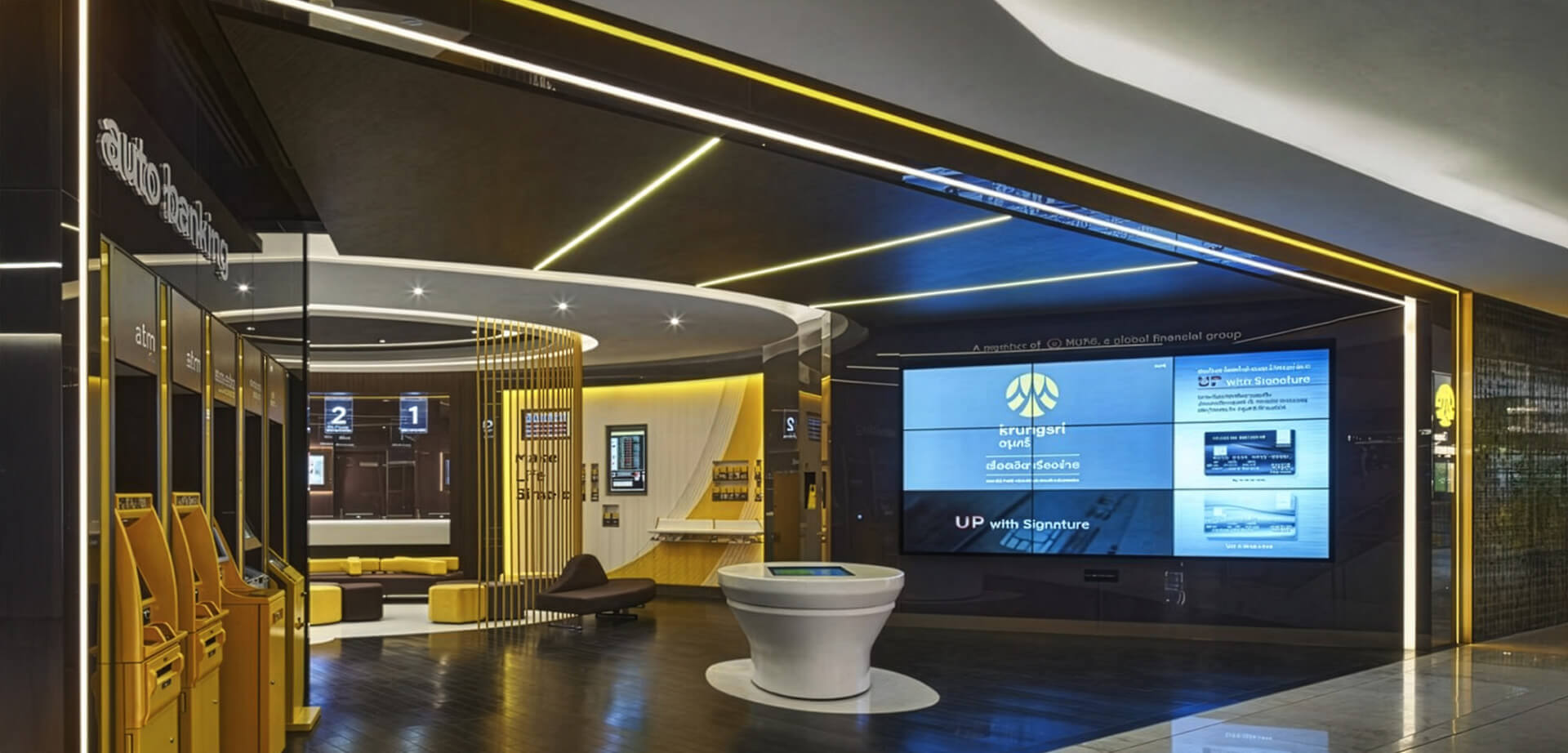
Above: Krungsri Bank branch in Thailand
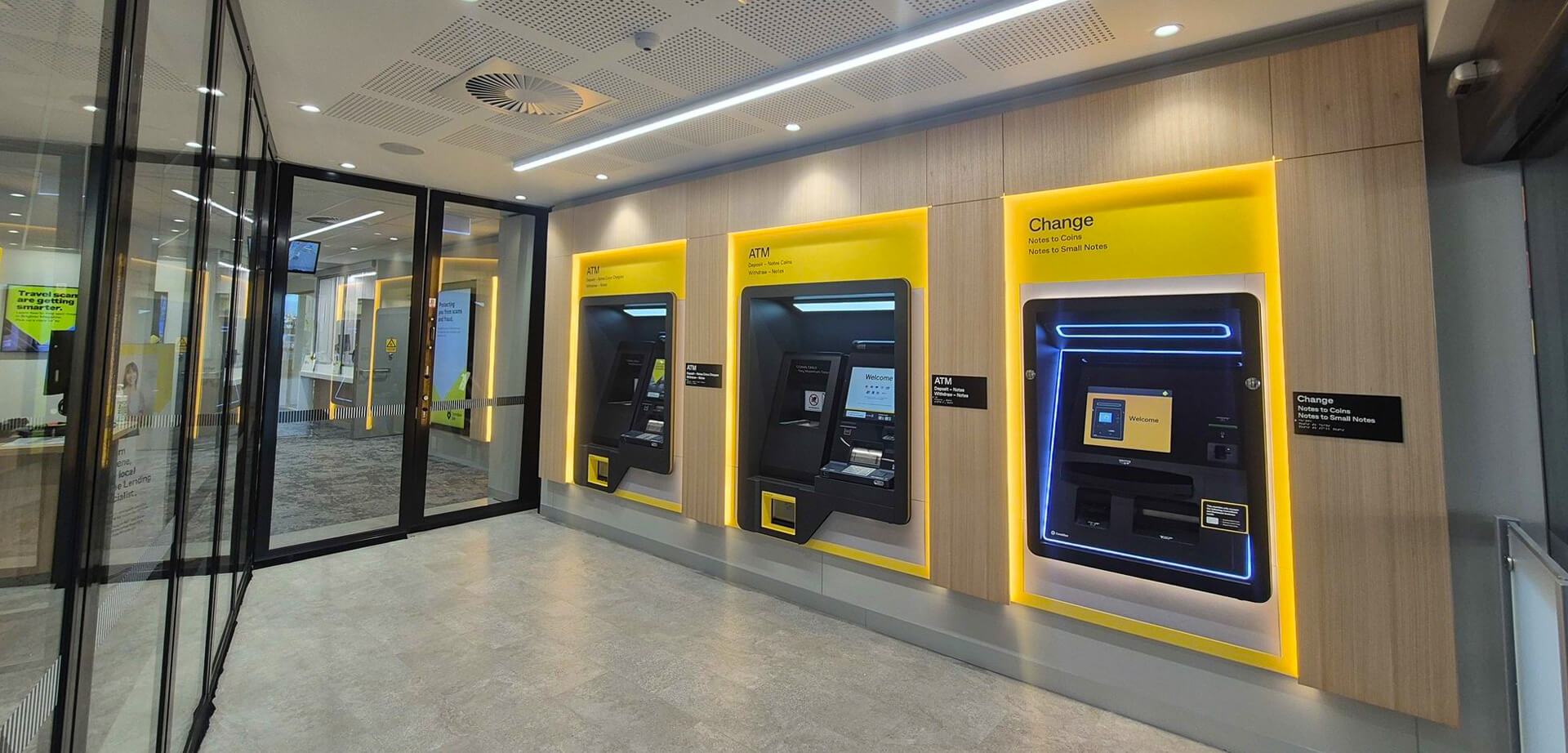
The Krungsri example illustrates how a distinctive brand identity can remain highly visible within a contemporary banking environment.
For management, the principle is important: AI does not reduce the importance of brand expression.
As routine banking becomes increasingly mediated by technology, the physical environment can become an increasingly important expression of trust, identity and differentiation.
From transaction centre to advisory experience hub
The role of the physical branch is changing from transaction processing towards higher-value customer interaction.
A useful strategic hierarchy is: Transaction → Service → Advice → Relationship
rather than: Queue → Counter → Exit
This has direct implications for space allocation.
Customers may enter through a digital discovery environment, move through self-service or assisted digital banking and then access increasingly private and personalised advisory spaces.
Open environments can support informal conversations.
Dedicated consultation areas can support mortgages, investments and other complex financial decisions.
Private rooms can support sensitive financial discussions.
Flexible meeting environments can support different customer and employee requirements throughout the day.
How CampbellRigg helps
CampbellRigg translates the desired customer journey into a spatial hierarchy.
Customer behaviour, service requirements, brand expression, privacy, technology and operational requirements are considered before detailed design begins.
The benefit: the branch is designed around the value of customer interaction rather than simply around the efficient processing of transactions.
The Competitive Risk: AI Could Mediate the Customer Relationship
The strategic issue extends beyond operational efficiency.
If third-party AI agents increasingly mediate product discovery, comparison and financial transactions, banks could find that customers interact with an external AI interface rather than directly with the bank.
McKinsey has identified this potential disintermediation risk, describing a future in which an external AI agent could search for financial products, compare options and execute transactions on a customer's behalf.
That creates a different management challenge.
The bank must protect the value of its customer relationship while AI changes how customers discover, evaluate and purchase financial services.
Brand therefore remains important.
So does physical experience.
When AI handles comparison and routine execution, the physical branch can provide human reassurance, specialist expertise, trust and a tangible expression of the bank's proposition.
How CampbellRigg helps
CampbellRigg connects brand strategy with the physical customer experience.
The process begins by auditing how the bank's proposition is currently expressed across digital and physical channels.
Strategy defines the desired positioning.
The design brief then translates that positioning into:
- customer experience;
- branch environment;
- identity;
- communications;
- digital-physical touchpoints;
- and implementation standards.
The benefit
Management receives a consistent brand proposition across the customer ecosystem, helping the physical network remain strategically relevant as AI changes how customers discover, compare and access financial services.

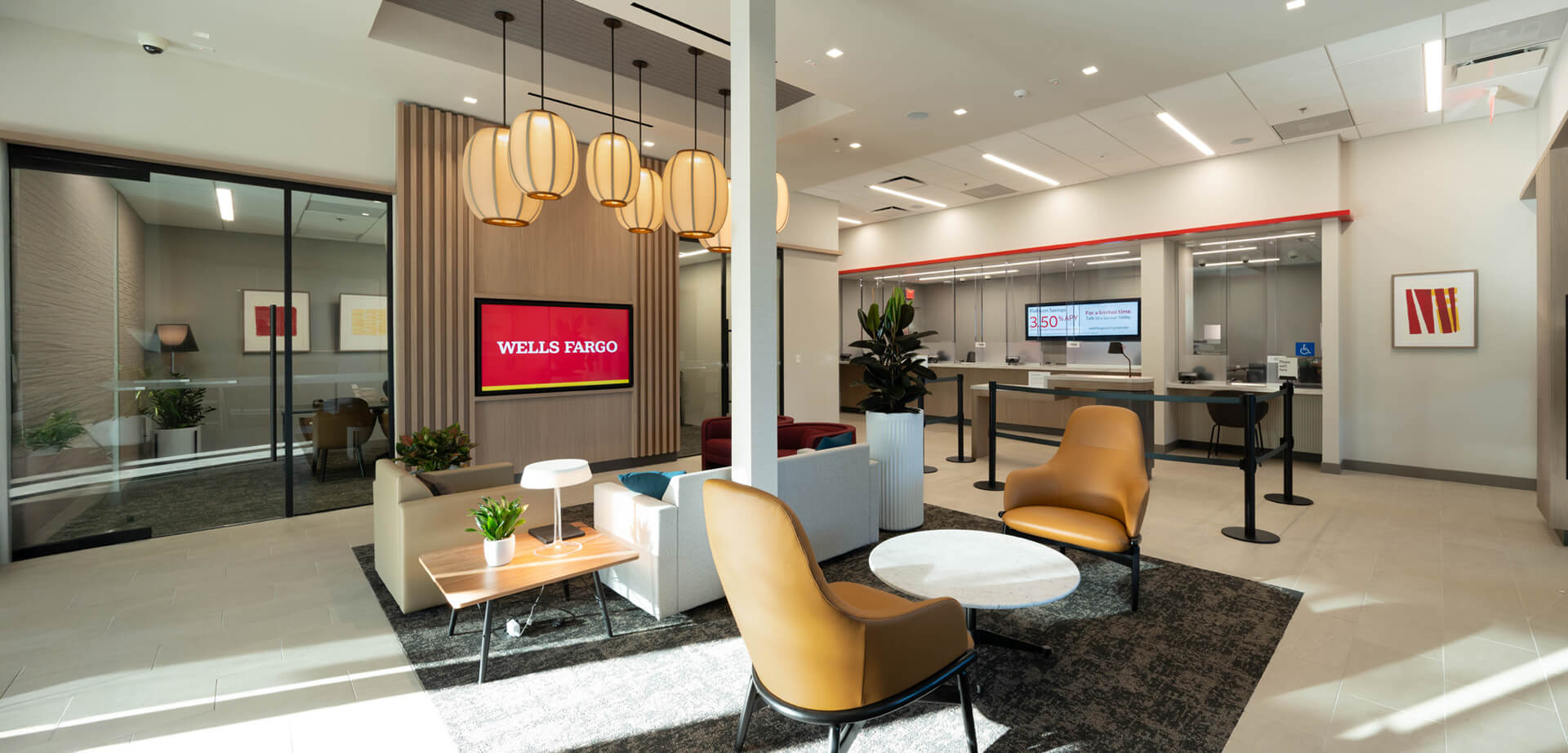
The Wells Fargo branch example demonstrates the movement away from bulky traditional teller lines towards consultation desks, digital self-service and flexible customer environments. The management implication is straightforward.
When routine transactions migrate to digital and AI channels, the physical branch can be planned around advice, privacy, flexibility and relationship value.
Build a modular phygital branch network
A national or international branch network rarely requires one universal physical format.
Different locations have different:
- catchments;
- customer profiles;
- property economics;
- footfall patterns;
- competitive environments;
- service requirements; and
- commercial objectives.
A scalable phygital network can therefore contain multiple formats.
- Micro-branches - Compact environments focused on essential services, digital discovery, self-service and advice.
- Advisory centres - Specialist environments focused on mortgages, wealth management, business banking or other complex financial services.
- Digital banking hubs - Technology-enabled environments supporting self-service, onboarding and assisted digital banking.
- Kiosks and satellite formats - Smaller physical touchpoints positioned within high-footfall locations.
- Flagship branches - Larger environments combining brand experience, advisory services, digital innovation, community engagement and specialist customer journeys.
- Pop-up banking environments - Flexible physical formats supporting new developments, targeted acquisition programmes, events or emerging markets.
The objective is not to create more formats for their own sake.
It is to establish a branch format architecture in which every physical model has a defined role.
The CampbellRigg Phygital Branch Network Framework
The strategic value of phygital banking comes from connecting network decisions rather than optimising individual components independently.
CampbellRigg's approach can be structured through eight connected decisions:
1. Network role - Define what the physical network needs to achieve within the bank's overall strategy.
2. Customer mission - Identify the customer journeys and financial needs for which physical interaction creates additional value.
3. Format architecture - Determine which branch formats are required and what role each should perform.
4. Customer journey - Map the movement between digital discovery, physical interaction, advice, transaction and ongoing digital relationship.
5. Spatial requirement - Translate customer and service requirements into zones, adjacencies, privacy levels, capacity and flexibility.
6. Digital integration - Define how mobile, online, self-service, data and other technologies interact with employees and physical space.
7. Brand experience - Ensure that architecture, interiors, communications, service and digital touchpoints express one coherent proposition.
8. Commercial performance - Define the measures that will determine whether the network is delivering value.
This framework turns phygital banking from a technology concept into a practical branch-network investment discipline.
The 5 pillars of phygital bank branch design
Within the wider network framework, five physical and operational components must work together.
1. Brand - The branch should communicate the bank's identity, values and proposition through architecture, interiors, graphics, materials and customer experience.
2. Digital - Mobile, web, self-service, data, AI-enabled services and other digital touchpoints should connect naturally with the physical environment.
3. Physical - Architecture and interior design should create the right balance of discovery, service, advice, privacy, flexibility and hospitality.
4. People - Employees remain critical where customers require expertise, reassurance, judgement and relationship management.
5. Performance - The environment should be designed around measurable outcomes including conversion, engagement, productivity, utilisation, customer satisfaction, cost-to-serve and return on investment.
The five pillars are interdependent.
A sophisticated digital interface cannot compensate for a poor customer journey.
An attractive branch cannot compensate for an unclear proposition.
A strong brand cannot compensate for inefficient space.
And technology investment cannot demonstrate value unless management can connect it to measurable customer, operational or commercial outcomes.
The objective is therefore not to optimise brand, digital, physical, people and performance separately.
It is to make them reinforce one another.

Measure the commercial performance of the phygital branch
Branch transformation should be measured as a business investment rather than simply a design project.
Relevant measures can include:
Customer performance
- customer acquisition;
- product conversion;
- appointment conversion;
- customer satisfaction;
- retention;
- relationship value; and
- digital adoption.
Operational performance
- employee productivity;
- assisted-digital utilisation;
- service time;
- space utilisation;
- cost-to-serve; and
- operational efficiency.
Commercial performance
- sales per square metre;
- product penetration;
- revenue contribution;
- investment payback;
- branch profitability; and
- return on invested capital.
The precise KPI set should reflect the role of each format.
A flagship branch should not necessarily be measured in exactly the same way as a micro-branch or specialist advisory centre.
That is why format strategy and performance measurement need to be developed together.
From branch redesign to network transformation
The greatest mistake in phygital banking is to treat branch transformation as a collection of individual design projects.
A bank may redesign one branch successfully while leaving the wider network fragmented.
A more scalable approach is: Strategy → network segmentation → format architecture → customer journeys → design standards → pilot → measurement → rollout
This creates a repeatable system.
The pilot branch then becomes more than a finished environment. It becomes a test of the wider operating model.
Management can assess:
- customer behaviour;
- employee response;
- technology adoption;
- spatial efficiency;
- service performance;
- brand experience;
- commercial outcomes; and
- investment requirements.
The resulting learning can then be translated into standards for subsequent locations.
This is how branch transformation becomes scalable.
How CampbellRigg helps banks turn phygital strategy into physical performance
CampbellRigg combines banking strategy, brand experience, customer journey thinking, physical environment design and implementation.
The role is not simply to design a branch after strategic decisions have already been made.
It is to help translate the bank's strategic ambition into a physical network that customers can understand, employees can operate and management can measure.
CampbellRigg's capabilities can include:
- banking brand and experience strategy;
- brand audit;
- customer journey and service design;
- phygital banking strategy;
- branch network strategy;
- branch format architecture;
- bank branch design and redesign;
- modular branch formats;
- digital and physical touchpoint integration;
- interior architecture;
- environmental design;
- customer experience design;
- design brief construction;
- implementation standards; and
- branch rollout.
The approach connects: Business strategy → customer proposition → brand → customer journey → format → space → technology → implementation → performance
That connection is the commercial value.

Why CampbellRigg's approach is different
Phygital banking can easily become a technology-led discussion.
But the strategic problem is broader.
Banks need to decide: where digital should lead; where people should lead; where physical space creates value; and how all three should work together.
That requires more than technology implementation.
It requires the integration of strategy, brand, customer behaviour, service design, physical environments and commercial measurement.
CampbellRigg's role is to bring those disciplines together so that the physical network reflects the bank's wider strategic direction.
The result is not simply a modern-looking branch.
It is a scalable branch network with defined roles, connected customer journeys, consistent brand experience and measurable performance objectives.

The future of phygital banking
Phygital banking is not the replacement of physical banking with digital technology.
It is the integration of: Digital + Physical + People + Brand + Performance
As customers become more comfortable with digital banking, the role of the physical branch is becoming more specialised.
Routine activity can increasingly move to digital and self-service channels.
Physical environments can concentrate on activities where human interaction creates additional value:
- advice;
- education;
- complex financial decisions;
- reassurance;
- relationship management;
- specialist expertise; and
- brand experience.
The strategic opportunity for banks is therefore not to ask whether branches will survive.
It is to determine what the branch network should become.
For banks planning their 2026/27 transformation strategies, the priority should be to redesign the network around the journeys customers actually want to make and the outcomes management needs each physical format to deliver.
The future bank branch is not simply a place to transact.
It is a connected customer-experience environment designed to turn digital relationships into deeper human relationships, stronger brand engagement and measurable commercial performance.
CampbellRigg helps banks translate phygital banking strategy into brand-led, customer-focused and commercially effective branch networks.
The management question is simple:
What should every branch in your network achieve and how should your digital, physical, people and brand investments work together to deliver it?