


News and Views
Agentic AI Bank Branches: How AI Is Transforming Banking & Branch Design





Agentic AI is transforming the bank branch from a transaction centre into an intelligent experience hub.
AI agents can increasingly support product discovery, onboarding, servicing and personalised banking journeys, while physical branches focus on advice, complex decisions, trust and relationship building. The result is a new model of retail banking combining AI, digital channels, human expertise, brand and physical experience.

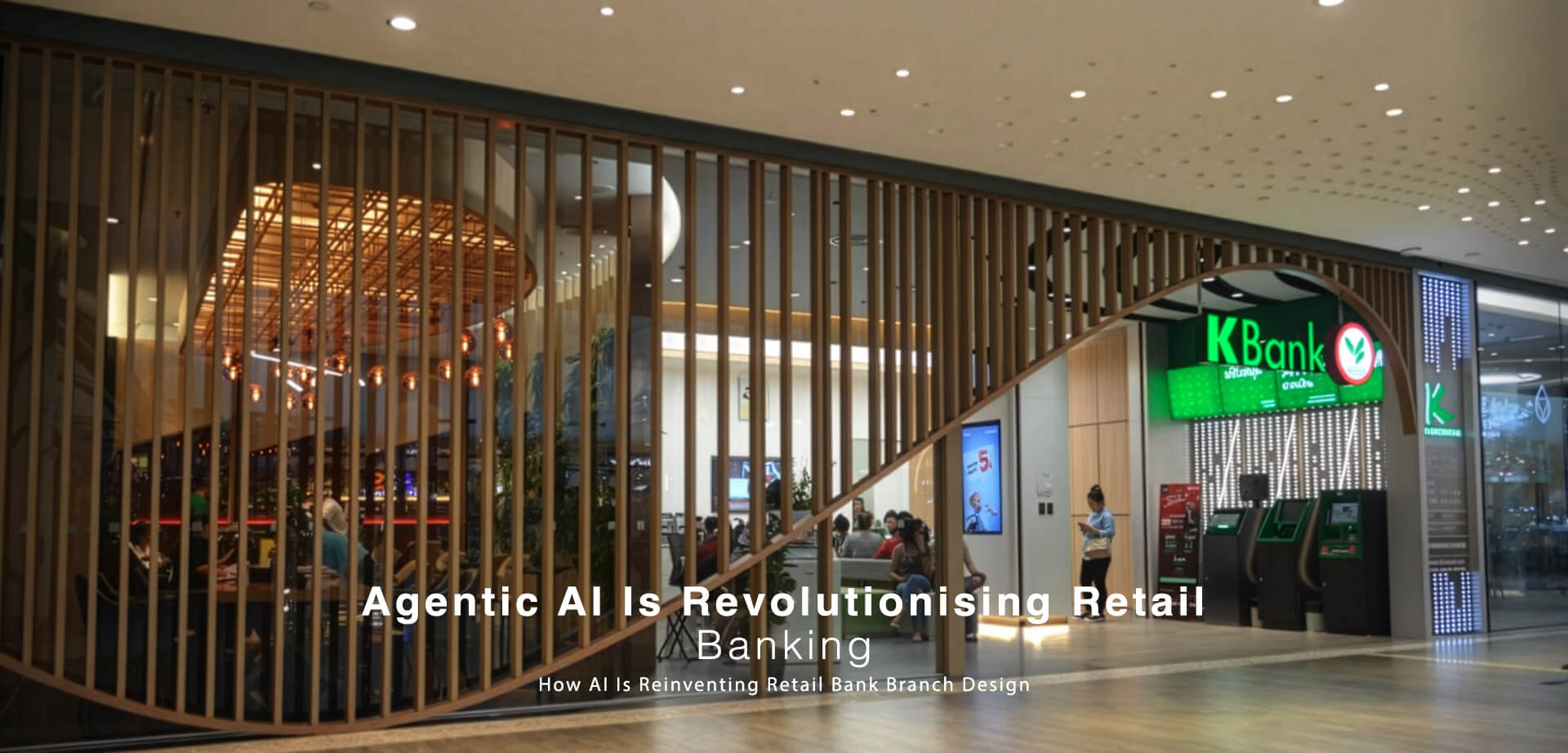
Above: KBank (Kasikornbank) branch and "The Wisdom Lounge" Thailand.
Why Agentic AI Matters to Bank Branch Strategy
For banks, agentic AI is not simply a technology upgrade. It can change the economics and purpose of the branch. By automating routine service, AI can create more capacity for high-value advice, mortgage conversations, wealth management, business banking and relationship building. Branch transformation should therefore be measured through conversion, customer engagement, advisory appointments, cost-to-serve, sales per square metre, loyalty and ROIC.
This changes the strategic question for banking executives.
Instead of asking “How do we put AI into our branches?”, banks should ask:
“How should we redesign the branch now that AI can transform the entire customer journey?”
That question connects artificial intelligence with bank branch design, banking branding, customer experience, architecture, digital transformation and commercial performance.
For banks planning an AI-enabled branch transformation, the opportunity is therefore considerably broader than technology deployment. It is a chance to redesign the physical expression of the banking brand around changing customer expectations.

What Is Agentic Banking?
Agentic banking is an emerging model in which AI agents can understand customer intent, analyse relevant information and coordinate or complete multi-step banking tasks within defined permissions, controls and human oversight.
Unlike conventional digital banking, where customers navigate menus, forms and multiple channels themselves, an AI agent can potentially coordinate several stages of a financial journey.
A customer might ask:
- Which financial product is right for me?
- Can you compare my options?
- Am I eligible?
- Can you prepare the next steps?
- Can you arrange an appointment with an adviser?
The customer moves from navigating the bank to asking the bank to act on their behalf.
The journey can therefore evolve from: App → Search → Forms → Service → Decision
to: AI intent → Recommendation → Eligibility → Processing → Human advice → Fulfilment → Proactive support
Agentic banking consequently changes not only digital banking, but also the role of people, places and brands.

How Is Agentic AI Changing Retail Banking?
Traditional AI has primarily answered questions, automated responses, identified patterns and supported employees.
Agentic AI goes further. An AI agent can potentially understand an objective, gather information, coordinate processes, recommend actions and execute defined tasks while escalating complex or sensitive decisions to human specialists.
Potential applications across retail banking include:
- Account opening and onboarding
- Mortgage and lending journeys
- Financial product discovery
- Customer servicing
- Fraud detection and prevention
- Appointment preparation and booking
- Financial guidance
- Documentation
- Proactive relationship management
- Personalised customer support
This creates an important distinction.
AI does not simply become another banking channel. It becomes an intelligent layer connecting channels, data, people and processes.
As routine interactions increasingly move into digital and AI-enabled environments, the physical bank branch must offer something more valuable than a transaction.

From Transaction Centre to Intelligent Experience Hub
The traditional bank branch was designed around: Queue → Counter → Transaction → Leave
The AI-enabled bank branch can instead be designed around: AI self-service → Discovery → Advice → Consultation → Experience → Relationship
As routine banking becomes increasingly automated, physical space can focus on activities where human interaction creates greater value:
- Financial advice
- Mortgage and wealth discussions
- Business banking
- Financial education
- Complex financial decisions
- Relationship building
- Community engagement
- Trust and reassurance
The branch becomes the physical layer of an intelligent banking ecosystem.
A customer could begin with an AI banking assistant at home, continue through mobile banking, visit a branch for a complex financial conversation and then return to an AI-enabled digital relationship afterwards.
The branch is no longer an isolated channel. It becomes part of a connected, phygital customer journey.

Bank Branch Transformation: From AI Strategy to Phygital Experience
AI-powered bank branch design moves away from transaction-led layouts towards flexible environments built around advice, discovery, privacy and relationships. Future branches may combine AI-enabled consultation rooms, digital product discovery, flexible advisory spaces, integrated mobile-to-branch journeys, intelligent signage and technology that supports employees without replacing human expertise.
The objective is not to fill the branch with technology. It is to redesign the physical environment around the customer journeys that AI makes possible.
This means considering the entire banking experience: what the customer sees before visiting the branch, what information the AI assistant has already gathered, how an adviser receives context, where confidential discussions happen and how the customer continues the journey afterwards.
Phygital banking therefore becomes a design principle rather than simply a technology proposition.

AI Bank Branch Design: What Changes?
AI-powered bank branch design is not about adding more screens.
It is about designing physical environments around the activities that AI cannot replace easily.
Future bank branch formats could include:
AI-enabled consultation spaces
Advisers can use customer-approved information and AI-generated insights to make conversations more relevant and productive.
Financial discovery zones
Interactive environments can help customers understand mortgages, savings, investments, insurance and other financial products.
Flexible advisory areas
Traditional counters can give way to adaptable spaces for confidential conversations, collaborative planning and relationship building.
Digital-to-physical touchpoints
Customers can move between mobile, web, AI assistants and branches without repeatedly providing the same information.
Trust and privacy environments
As AI becomes involved in financial decisions, transparency, security, privacy and human oversight need to become visible parts of the customer experience.
The future bank branch is therefore less about transaction capacity and more about customer value per visit.
Banking Branding in the Age of Agentic AI
Agentic AI creates a new banking brand touchpoint: the AI agent itself. Its language, recommendations, personality, transparency and behaviour can influence how customers perceive the bank.
Banking brands therefore need consistency across AI assistants, mobile banking, websites, digital communications, branch environments, signage and human interactions.
The future banking brand is not simply a visual identity. It is a connected experience spanning technology, people, physical space and customer journeys.
This makes banking branding strategy increasingly inseparable from bank branch design.
Architecture, interior design, digital interfaces, AI experiences, communications and employee interactions need to reinforce the same brand promise.
For a bank, every customer interaction can become part of the brand.

How AI Changes the Banking Customer Journey
Consider a mortgage journey.
A traditional journey might look like: Search → Compare → Forms → Contact bank → Appointment → Branch → Advice → Application
An agentic journey could become:
Customer states objective → AI identifies relevant information → Eligibility assessment → Options explained → Documentation prepared → Human advice recommended → Appointment booked → Adviser receives context → Complex decisions discussed → Application continues digitally
The branch has not disappeared. Its role has become more valuable.
The customer arrives better informed, while the adviser can focus on judgement, expertise, reassurance and relationship building.
This is why AI banking customer experience and bank branch transformation should be considered together.

Five Components of an AI-Powered Bank Branch
A successful AI-powered branch should operate as an integrated system.
1. AI agents → understand customer intent and coordinate defined banking tasks.
2. Digital banking → connects mobile, web, remote advice and branch experiences.
3. Intelligent space → creates environments for discovery, advice, education and privacy.
4. Human expertise → provides judgement, empathy, reassurance and specialist advice.
5. Brand experience → maintains a consistent identity across AI, digital and physical touchpoints.
Together, these components create a phygital banking ecosystem in which technology and physical experience reinforce one another.

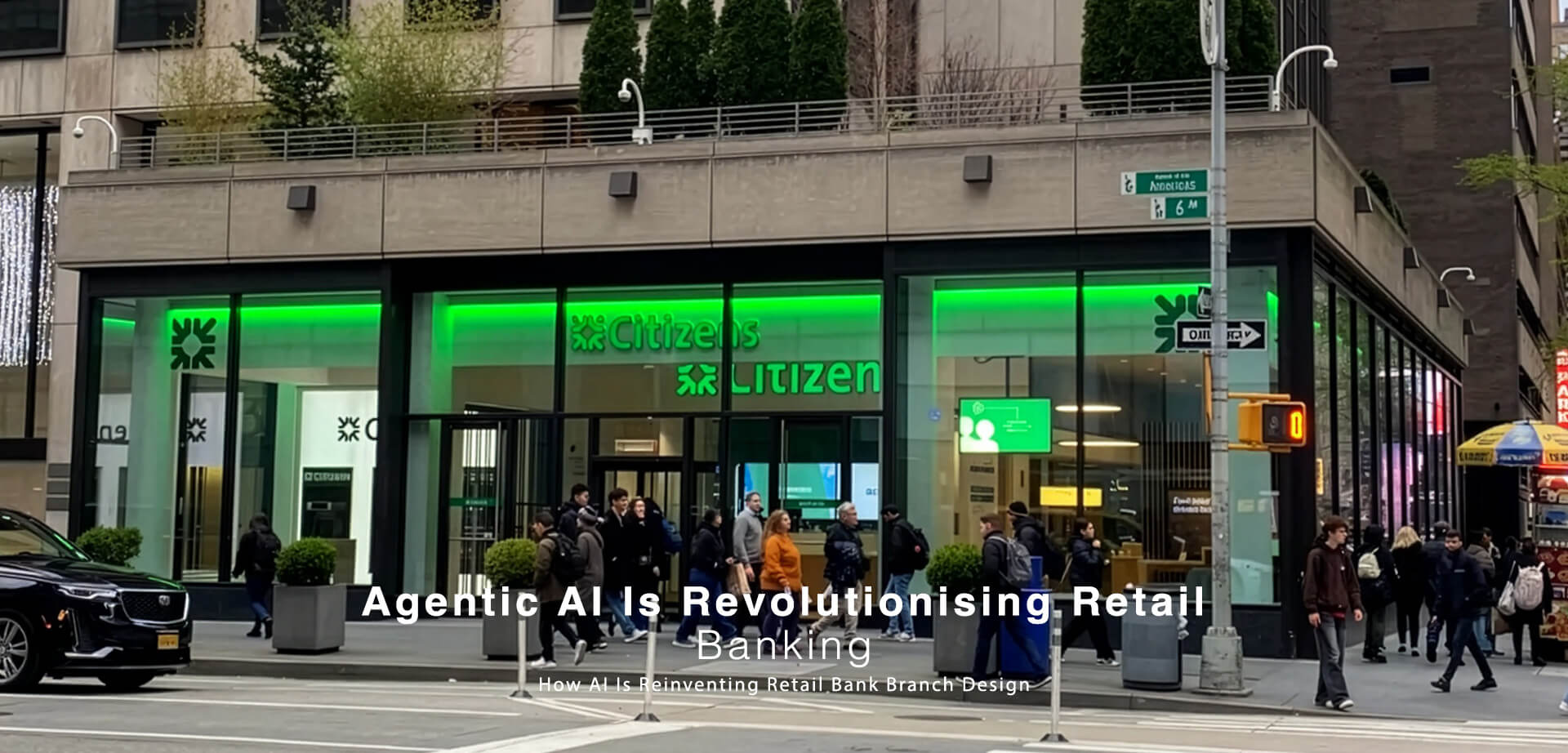
Above: First Citizens Bank branch at the Brewery BlocksTacoma, Washington.
How Banks Are Using Agentic AI
Banks are moving from experimentation towards specific AI-enabled workflows.
OCBC and DBS have deployed agentic AI applications in areas including private-banking onboarding, while Lloyds Banking Group has been developing AI-agent applications supporting fraud operations and scam assessment.
The significance is not simply that banks are deploying AI.
It is that AI is beginning to influence the structure of banking services.
The emerging model combines: AI automation + data + human judgement + proactive service
For bank branch strategy, the consequence is clear: physical environments should be designed around the services that remain most valuable when routine processes become automated.

Seven Principles for Designing an AI-Powered Bank Branch
1. Map AI-enabled customer journeys
Identify where AI should automate, augment or support each stage.
2. Redesign around customer value
Move from transaction-led planning towards advice, discovery and relationships.
3. Connect physical and digital channels
Allow customers to move between AI, mobile, web and branch without losing context.
4. Design for trust
Make privacy, transparency, security and human oversight integral to the experience.
5. Create flexible advisory environments
Support complex conversations, financial education and relationship building.
6. Align the brand across every touchpoint
Connect the AI assistant, app, website, branch and employee experience.
7. Measure commercial impact
Track engagement, conversion, advisory appointments, customer satisfaction, branch utilisation, cost-to-serve, sales per square metre, retention and ROIC.
The objective is not technology for its own sake.
It is better customer experience and stronger commercial performance.

Commercial Transformation: Turning AI Strategy into Banking Experience
Banks implementing agentic AI need more than technology integration. They need to rethink customer journeys, branch formats, banking brand experience and physical environments.
CampbellRigg connects banking brand strategy, customer experience, branch strategy, architecture, interior design, digital touchpoints, phygital strategy and commercial performance to help banks translate AI transformation into future-ready branch environments.
The result is a banking experience designed around customer needs, human expertise, intelligent technology and measurable commercial performance.
This integrated approach brings together bank branch strategy, bank branch design, banking branding, architecture, interior design, customer journey planning, digital-physical integration, phygital experience design and ROIC.
For financial institutions considering an AI-powered branch transformation, this creates a direct connection between strategic intent and physical implementation

Planning an AI-Powered Bank Branch?
CampbellRigg helps banks connect AI strategy with banking brand strategy, customer experience, branch design, architecture, digital touchpoints and commercial performance.
Explore how your bank branch could become an intelligent experience hub.
The Future of Retail Banking Is Phygital
Agentic AI is not simply making banking more automated. It is changing the relationship between technology, people, place and brand.
The future bank is not just an app, an AI assistant or a branch. It is an intelligent, connected ecosystem in which AI agents, digital platforms, data, human expertise and physical experience work together.
AI provides convenience, personalisation and intelligent support. People provide judgement, empathy, expertise and trust. Design connects the two.
The bank branch is therefore evolving from a transaction centre into an intelligent experience hub: smarter, more experiential, more human and more commercially valuable.
The strategic question for banks is no longer: “How should AI be installed in the branch?”
It is: “How should the entire banking experience be redesigned around intelligent technology and human expertise?”
That is the new strategic role of AI bank branch design, banking branding and phygital customer experience.